
Can I Revoke Part Of My Will Without Revoking The Entire Document?
A will is a powerful legal document, but it’s not a casual undertaking. Many clients ask if they can simply cross out sections or add handwritten notes to their existing will. While technically possible, this is legally risky and often invalid in California. An experienced wills attorney can explain the dangers of informal amendments and the proper methods for updating your estate plan. The law requires strict adherence to specific formalities to ensure your wishes are legally enforceable.
A comprehensive estate planning strategy isn’t just about having a will; it’s about creating a coordinated structure that addresses all your assets and potential contingencies. A will is often the cornerstone of that plan, but it’s essential to understand how it interacts with other estate planning tools like trusts, powers of attorney, and healthcare directives.
Can I use a codicil to change my will?
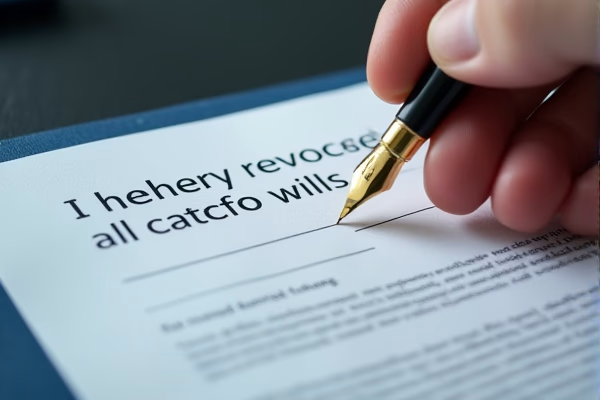
A codicil is a legal document that amends a will. It’s a more formal way to make changes than simply crossing things out. However, a codicil must be executed with the same level of formality as the original will – meaning it requires the same number of witnesses and adherence to all California Probate Code requirements.
Legally, a codicil “republishes” the entire original will as of the date the codicil is signed. This is important because it can reset statutory timelines for omitted heirs or trigger changes based on tax law updates.
What happens if I physically destroy part of my will?
If you intentionally tear up, burn, or cancel a portion of your will with the intent to revoke it, that portion is generally considered revoked. However, partial revocation can be legally complex. Crossing out a name on a typed will, for example, is often deemed invalid in California because it doesn’t demonstrate a clear intent to revoke the entire document.
Under Probate Code § 6120, a Will is revoked either by a subsequent legal instrument (a new Will or Codicil) or by a physical act of destruction performed with the specific intent to revoke.
Can I revive a revoked will?
If you revoke a will and then change your mind, you can sometimes “revive” it. However, this isn’t automatic. If you revoke a second will, the first will remains revoked unless it’s evident from the circumstances or subsequent declarations that you intended to restore the original document. Simply destroying the “new” will does not automatically bring the “old” one back to life.
As outlined in Probate Code § 6123, statutory revival requires clear evidence of intent to reinstate the original will.
What if I revoke my will by mistake?
If you revoke a will based on a mistaken belief – for example, thinking a new will is valid when it isn’t – the court may be able to “undo” the revocation under the doctrine of Dependent Relative Revocation (DRR). This prevents your estate from falling into intestacy due to a technical drafting error.
Under the DRR doctrine, if a testator revokes an old Will based on the mistaken belief that a new Will is valid, the court may “undo” the revocation of the old Will if the new one fails. This prevents an estate from falling into intestacy due to a technical drafting error.
What if someone tries to influence me to change my will?
California law recognizes the concept of undue influence, which occurs when someone exerts excessive pressure on you to change your will in a way that doesn’t reflect your true wishes. Gifts to non-family caregivers are legally presumed fraudulent, and contesting a will based on undue influence requires demonstrating a pattern of coercive behavior.
California uses a “Four-Prong Test” to identify undue influence: victim vulnerability, influencer authority, tactics used, and result inequity. WIC § 15610.70 and Probate Code § 21380 provide further guidance on this complex legal issue.
What if I want to make sure no one can contest my will?
You can include a “no-contest clause” in your will, which discourages beneficiaries from challenging its validity. However, these clauses aren’t always enforceable. A no-contest clause is only enforceable against contests brought without probable cause. If a beneficiary has reasonable facts to believe a Will is invalid, they may contest without forfeiting their inheritance.
The “Probable Cause” Shield (Probate Code § 21311) protects beneficiaries who challenge a will with legitimate legal grounds.
Can I avoid probate by transferring my home to my heirs?
As of April 1, 2025, a primary residence up to $750,000 can bypass formal probate via a “Petition to Determine Succession” (Form DE-315). This is a streamlined process available under AB 2016. However, it’s important to distinguish this from the more complex process of a full probate proceeding.
Distinguish between the Small Value Affidavit and the AB 2016 Succession Petition.
What’s the difference between separate and community property in California?
Understanding the distinction between separate and community property is crucial for estate planning. Changing separate property into community property requires an express, written “transmutation” declaration. Adding a spouse to a deed is often legally insufficient.
The Transmutation Rule (Family Code § 852) outlines the requirements for legally changing the character of property.
What are the federal estate tax implications for high-net-worth individuals?
The Federal Estate Tax Exemption is permanently fixed at $15 million per person ($30 million for couples) as of January 1, 2026. California has NO state estate tax. However, it’s important to understand how the One Big Beautiful Bill Act (OBBBA) impacts estate planning for high-net-worth individuals.
Cite the One Big Beautiful Bill Act (OBBBA).
How do I handle retirement accounts in my estate plan?
Retirement accounts are classified as Income in Respect of a Decedent (IRD). They do NOT receive a basis adjustment under IRC § 1014. Beneficiary designations control the distribution of these assets, and they typically bypass probate.
As an estate planning attorney & CPA with over 35 years of experience in San Diego, California, I’ve seen firsthand the complexities of retirement account planning. Understanding the SECURE Act 2.0 and the 10-year rule for inherited accounts is critical to minimizing tax liabilities and ensuring a smooth transition for your beneficiaries. The CPA advantage lies in integrating tax considerations into your estate plan, maximizing the step-up in basis for other assets, and accurately valuing your estate to avoid unnecessary taxes.
|
Attorney Advertising, Legal Disclosure & Authorship
ATTORNEY ADVERTISING.
This content is provided for general informational and educational purposes only and does not constitute legal, financial, or tax advice.
Under the California Rules of Professional Conduct and State Bar advertising regulations, this material may be considered attorney advertising.
Reading this content does not create an attorney-client relationship or any professional advisory relationship.
Laws vary by jurisdiction and are subject to change, including recent 2026 developments under California’s AB 2016 and evolving federal estate and reporting requirements.
You should consult a qualified attorney or advisor regarding your specific circumstances before taking action.
Responsible Attorney:
Steven F. Bliss, California Attorney (Bar No. 147856).
Local Office:
San Diego Probate Law3914 Murphy Canyon Rd San Diego, CA 92123 (858) 278-2800
San Diego Probate Law is a practice location and trade name used by Steven F. Bliss, Esq., a California-licensed attorney.
About the Author & Legal Review Process
This article was researched and drafted by the Legal Editorial Team of the Law Firm of Steven F. Bliss, Esq.,
a collective of attorneys, legal writers, and paralegals dedicated to translating complex legal concepts into clear, accurate guidance.
Legal Review:
This content was reviewed and approved by Steven F. Bliss, a California-licensed attorney (Bar No. 147856).
Mr. Bliss concentrates his practice in estate planning and estate administration, advising clients on proactive planning strategies and representing fiduciaries in probate and trust administration proceedings when formal court involvement becomes necessary.
With more than 35 years of experience in California estate planning and estate administration,
Mr. Bliss focuses on structuring enforceable estate plans, guiding fiduciaries through court-supervised proceedings,
resolving creditor and notice issues, and coordinating asset management to support compliant, timely distributions and reduce fiduciary risk.
|